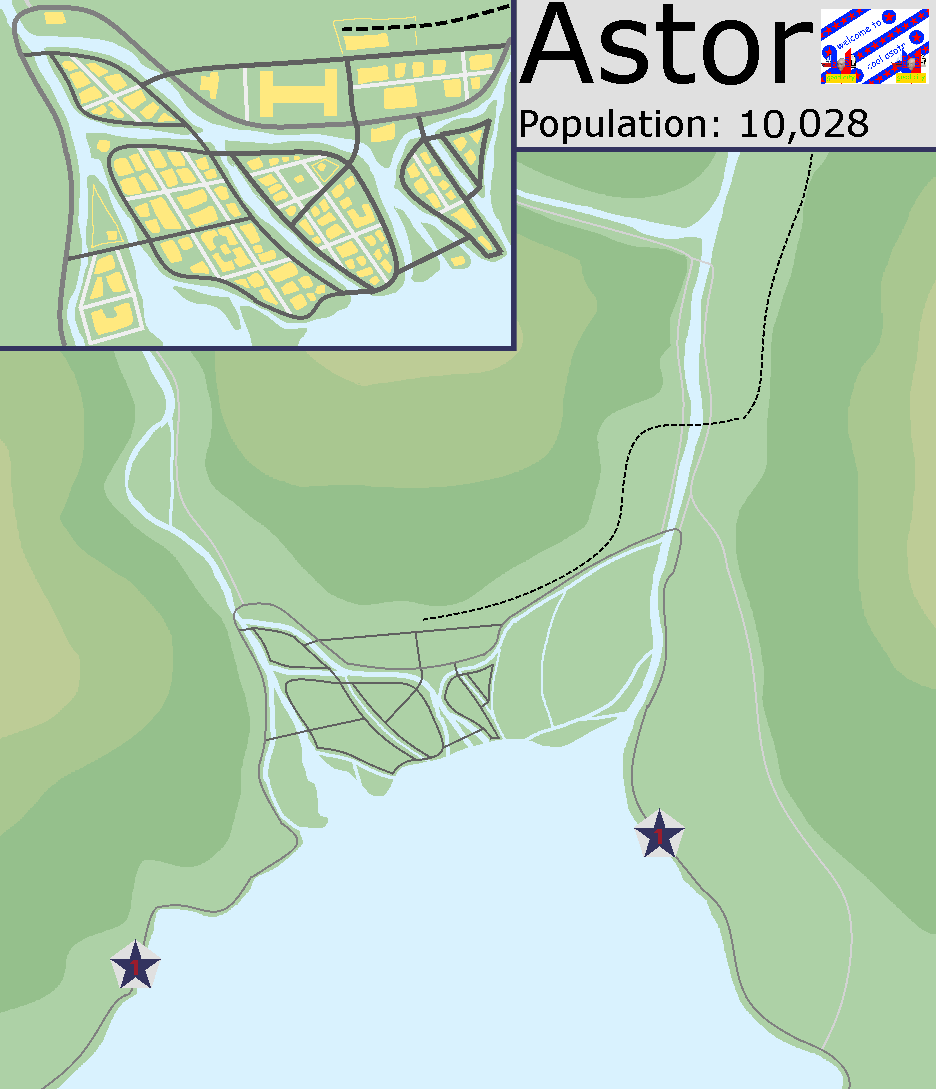
Astor is the second oldest major settlement on Ochay, tracing it's roots back to the usage of the island as a place to smuggle goods in and out of Japan during the maritime fur trade. Japan was under it's Sakoku policy at the time, which meant foreign trade was very limited. Ochay, as an island the shogunate didn't care too much about, began to be used as a meeting ground between Japanese businessmen and European traders - goods would be smuggled in the hulls of fishing vessels. The American Fur Company decided to capitalize on this trade in 1819 by founding Port John Jacob Astor - named after the AFC's founder. The port would quickly grow into one of the biggest hubs for unsavory characters in the pacific, due to it's semi-illegal nature. The decline of the mairitme fur trade led to the abandonment of the Port by AFC authorities in 1849, but the settlement was still continously inhabited. The Americans would again be the ones to pick back up developing the city after they invaded the island in 1945, turning it into the capital of the territory under their control and building port facilities on it. After the Vladivostok Accords, Prime Minister Takemoto led Astor in developing a tourist industry for Americans, but these plans were neglected and forgotten about by the subsequent Borya government. During the days of the Vietnam government, Astor saw a new life as the main base for US Forces, it's streets being flooded with GIs, not all of them particularly happy to be there. The city would go into dormancy once more as the Soviets administered the island. In the May Revolution, Astor was again the base for US Forces, and as such was the site for the final battles of the Revolution before the US withdrew. It's stitched up the wounds from the Revolution rather well since then, dismantling the military bases and converting the port into a thriving marina.
The Heartlake Springs Mall is a formerly abandoned mall between Cedar Avenue and Highway One. It was supposed to be the 3rd-largest mall in the Eastern Hemisphere upon it's completion, a project of collaboration between the Japanese Oriental Land Company and the American General Growth Properties. Millions upon millions of dollars went into the project, one that some say was planned even before the Rolling Invasion of 1983. The construction workers only got the outside skeleton of the building done before they were forced to abandon it as the Americans retreated from Ochay. The people of Astor, not wanting to simply demolish it and leave an eyesore of an empty lot, instead finished the construction as was planned and turned it into a community center. It remains to this day, maintained by the Astor Historical Society and designed to evoke 'The quintessential mall experience with an Ochay twist'. Lectures, game nights, community clubs, and other such activities abound at Heartlake Springs Mall.
The Maritime Cooperative is the result of Astor's long tradition of ships and docks, the former site of a military naval port converted into a shipbuilding workshop and musuem. It's located off Elm Avenue in the southeast of town. The workshop makes kayaks, canoes, and even small motorboats, while the musuem showcases the history of the craft in Ochay over time. Just a few years ago, cooperative members were able to lift from the bottom of the ocean a Port J.J. Astor-era vessel called the Standard, tug-boat it to the main dock of the coop, and restore it to previous working order. Every few days the Standard takes off for a voyage around the island that people can come along with, learning about the ship, it's history, and the seas around Ochay.
The Yankee Delta is the fanning out of the river across the plains that make up Astor, creating an environment that's almost swampy. A number of people offer guided boat tours of the Delta, highlighting the Delta's history in being the site of the last major battles of the May Revolution. In it's final reaches, hundreds of boats navigated the waters, engaging in guerilla actions against the occupying US forces that ultimately prevailed in ousting them from Ochay altogether. Of course, people are fully capable of planning their own trips around the Delta, with it's many quiet streams and disused shacks offering ideal locations to look around and relax in.
The Maritime Cooperative offers their docks for use as passenger recieving docks, so ferries or ships coming in from outside the island will often be seen there. At the northern edge of town is the southern terminus for the Paradise Line passenger railroad, taking off twice a day for Mizero and Frolov. And, of course, the town has frequent service by Ochay Transit's intercity and intracity bus lines.
If the link in the image to the city map does not work, use this link.