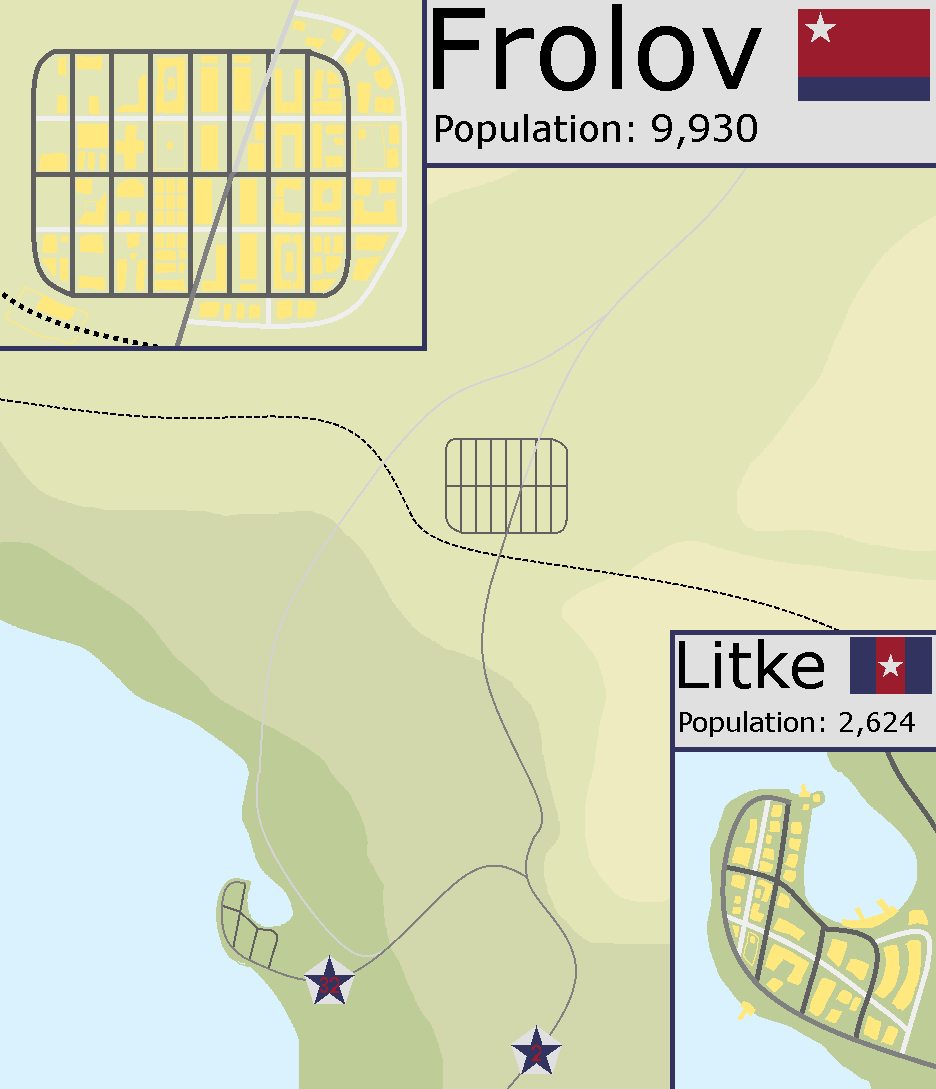
Frolov was founded in 1946 as an administrative hub for the Soviet-controlled areas of the island when the island was split. The site was chosen due to it's relative flatness as well as it's proximity to both Lake Stanart and the still-under construction Point Revanoz port facility. It was a small and modest town during the tenure of Prime Minister Takemoto - it was under Borya's rule that the city became what it is today. The Frolov Plan for Urban Development, often shortened to the Frolov Plan, planned to uproot the entire city and replace it with a planned brutalist metropolis. Borya was overthrown in Operation Midnight Revue before the plan could be completed, but Vetrov picked it back up during his tenure, and the Frolov Plan still largely defines the makeup of the town to this day. Frolov was the site of the largest battle of the May Revolution, where the coalition that would go on to sign the Ochay Declaration took both the US occupation forces and Vetrov's remaining military units by surprise, driving them out of the city after a week of intense, bloody fighting. Since the Revolution, the city has flourished, using the Frolov Plan's remnants to build a comfortable, environmentally friendly, and peaceful city.
The Palm Building, located on the corner of 6th and 9th, was the crown jewel of the Frolov Plan, the tallest building on the island by far at 50 stories tall. It was designed to be an all-purpose building, being the administrative center of the island, a massive source of housing, and an economic hub through the Ecosyn computer system. Only about half of these aims were completed by the time Borya was ousted, and during the Vietnam era the building sat unused, save for the already completed bottom 11 floors. As with the rest of the Frolov Plan, Vetrov's government restarted the construction of the Palm Building soon after assuming power, though he was still unable to complete the building, only getting to the 43rd floor before the US invasion started. The state of the building was an open question for a few years, until in 1989 it's people decided to finally finish it, but with an Ochay twist. Instead of simple drab concrete, sweeping glass panes and ample foilage were added to give the brutalism a green look. In fact, the reason it's called the Palm Building is because the final five 'capstone' floors were made to look like the fronds of a palm unfurling - before this, it was simply called the Frolov General Administration Complex. Today, hundreds of people live, labor, and create in the Palm Building, in addition to it's housing of the Frolov Communual Administration.
The Frolov Underground, or simply the Underground, is the general name for the immense series of tunnels, bunkers, offices, and barracks that lie underneath Frolov and it's surrounding area. Another project of the Frolov Plan, USP planners thought that it would render the island much safer from potential invasion or bombing, as well as creating new space for citizens to work and live in. Vetrov converted it to a mainly military project, building a number of nuclear missile silos connected to the Underground. Today, the people of Frolov and the Frolov Underground Maintenance Society have mapped, tamed, and made usable a good number of the facilities, but there still lies untold miles of concrete seldom tread on for decades. The Maintenence Society has reporting journals for people who want to venture into the unmapped quadrants, but also offers guided tours of the more known parts of the underground.
Since the Vietnam era and a wave of USO performers, Frolov has been a hub for music and musicians of all kinds. Figures such as Pete Seeger, Phil Ochs, and even on one occasion Elvis all performed on the island. This, combined with the effect of a lot of more creative-minded GIs going GPI meant that music was a powerful part of the culture. This was only amplified when the May Revolution was carried in part off the back of popular protest songs being sung and chanted. One of the first things the Ochayans did after liberating Frolov was to hold a grand concert in the city, specifically at the Grand Concert Hall on the corner of 6th and 5th, built by Borya in 1961 in preparation of a Pacific Socialist Union Orchestra that never materialized. Every year since, the Hall has hosted the Revolutionary Concert Festival in May to commemorate it. The Hall is not quiet in other parts of the year, instead it very frequently has local and foreign bands on stage to play the hits and the songs that slip through the cracks. In addition, the Hall has a host of music lectures and classes for those wishing to learn the trade.
Frolov is home to one of Ochay's two major airports, the Zubkov-Craine Regional Airport. It's only capable of taking flights from the western Hawaiian islands and Japan, but is still frequented by Ochayans and tourists alike. It also serves as the middle point of the Paradise Line passenger rail line and the terminus of Highway Two - the Local Route does, however, continue on to Point Rezanov on the coast. Inside the city can be found the Monorail, servicing a number of buildings in the center of town, as well as the expected Ochay Transit bus service both in and out of the city.

If the link in the image to the Frolov map does not work, use this link.
If the link in the image to the Litke page does not work, use this link.